Download access and reimbursement support resources to help your patients with access to KLYGEFA.
KLYGEFA is indicated for the treatment of generalized myasthenia gravis (gMG) in adult patients who are anti-acetylcholine receptor (AChR) antibody positive. 1
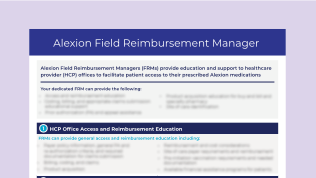
Field Reimbursement Manager Support Services
Learn how your Alexion Field Reimbursement Manager can work alongside you and your staff to help navigate access and reimbursement for prescribed Alexion therapies.
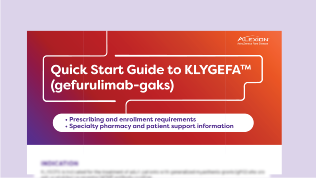
Quick Start Guide to KLYGEFA
A quick guide to help your office navigate the steps to get patients started on KLYGEFA.
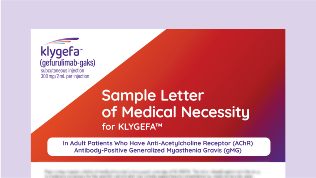
Klygefa gMG Sample Letter of Medical Necessity
A template letter healthcare providers can use when responding to insurance requests for a letter of medical necessity for KLYGEFA.
KLYGEFA gMG Letter of Appeal
A template that you can fill out to assist with the appeals process if coverage for KLYGEFA in gMG is denied.

Compendium of gMG References for KLYGEFA
A collection of key references for KLYGEFA in gMG, including Prescribing Information, the FDA approval letter, and publicly available evidence for healthcare providers.
KLYGEFA gMG Common Prior Authorization Criteria
A guide to help your office understand common payer criteria for prior authorization of KLYGEFA in gMG and navigate the PA process.
KLYGEFA gMG Coding & Billing Guide
A guide to help your office navigate coding, billing, and claims for KLYGEFA.
KLYGEFA Access & Reimbursement Guide
A comprehensive guide to help your office navigate the steps to get patients started on KLYGEFA.
Guide to Peer-to-Peer Medical Reviews
A guide to help you and your office understand the peer-to-peer review process and how it can be used as a step before submitting a formal appeal.
Reauthorization Guide
A guide to help your office navigate the reauthorization process, including health plan requirements and timing considerations.
Get your patients started with OneSource
OneSource, a personalized patient support program offered by Alexion, is available Monday through Friday, 8:30 AM–8 PM ET.
- Complete or update vaccination for meningococcal bacteria (for serogroups A, C, W, Y, and B) at least 2 weeks prior to the first dose of KLYGEFA, unless the risks of delaying KLYGEFA therapy outweigh the risk of developing a serious infection. Comply with the most current Advisory Committee on Immunization Practices (ACIP) recommendations for meningococcal vaccination in patients receiving a complement inhibitor. See Warnings and Precautions (5.1) for additional guidance on the management of the risk of serious infections caused by meningococcal bacteria.
- Patients receiving KLYGEFA are at increased risk for invasive disease caused by Neisseria meningitidis, even if they develop antibodies following vaccination. Monitor patients for early signs and symptoms of meningococcal infections and evaluate immediately if infection is suspected.
- Initiation in patients with unresolved serious Neisseria meningitidis infection.
WARNINGS AND PRECAUTIONS
Serious Meningococcal Infections
KLYGEFA, a complement inhibitor, increases the patient’s susceptibility to serious, life-threatening or fatal infections caused by meningococcal bacteria (septicemia and/or meningitis) in any serogroup, including non-groupable strains. Life-threatening and fatal meningococcal infections have occurred in both vaccinated and unvaccinated patients treated with complement inhibitors.
Revaccinate patients in accordance with ACIP recommendations considering the duration of KLYGEFA therapy. Note that ACIP recommends an administration schedule in patients receiving complement inhibitors that differs from the administration schedule in the vaccine prescribing information. If urgent KLYGEFA therapy is indicated in a patient who is not up to date with meningococcal vaccines according to ACIP recommendations, provide antibacterial drug prophylaxis and administer meningococcal vaccines as soon as possible. Various durations and regimens of antibacterial drug prophylaxis have been considered, but the optimal durations and drug regimens for prophylaxis and their efficacy have not been studied in unvaccinated or vaccinated patients receiving complement inhibitors, including KLYGEFA. The benefits and risks of treatment with KLYGEFA, as well as those associated with antibacterial drug prophylaxis in unvaccinated or vaccinated patients, must be considered against the known risks for serious infections caused by Neisseria meningitidis.
Vaccination does not eliminate the risk of serious meningococcal infections, despite development of antibodies following vaccination.
Closely monitor patients for early signs and symptoms of meningococcal infection and evaluate patients immediately if infection is suspected. Inform patients of these signs and symptoms and instruct patients to seek immediate medical care if they occur. Promptly treat known infections. Meningococcal infection may become rapidly life-threatening or fatal if not recognized and treated early. Consider interruption of KLYGEFA in patients who are undergoing treatment for serious meningococcal infection, depending on the risks of interrupting treatment.
KLYGEFA REMS
Due to the risk of serious meningococcal infections, KLYGEFA is available only through a restricted program called KLYGEFA REMS.
Prescribers must enroll in the REMS, counsel patients about the risk of serious meningococcal infection, provide patients with the REMS educational materials, assess patient vaccination status for meningococcal vaccines (against serogroups A, C, W, Y, and B) and vaccinate if needed according to current ACIP recommendations 2 weeks prior to the first dose of KLYGEFA. Antibacterial drug prophylaxis must be prescribed if treatment must be started urgently, and the patient is not up to date with both meningococcal vaccines according to current ACIP recommendations at least 2 weeks prior to the first dose of KLYGEFA. Patients must receive counseling about the need to receive meningococcal vaccines and to take antibiotics as directed, signs and symptoms of meningococcal infection, and be instructed to carry the Patient Safety Card at all times during and for 3 months following KLYGEFA treatment.
Further information is available at www.KlygefaREMS.com or 1-888-765-4747.
Other Serious Infections
KLYGEFA blocks terminal complement activation; therefore, patients may have increased susceptibility to infections, especially with encapsulated bacteria, such as infections caused by Neisseria meningitidis but also Streptococcus pneumoniae, Haemophilus influenzae, and Neisseria gonorrhoeae. Serious infections with Neisseria species (other than Neisseria meningitidis), including disseminated gonococcal infections, have been reported in patients treated with complement inhibitors.
Administer vaccinations for the prevention of Streptococcus pneumoniae infection according to ACIP recommendations. Patients receiving KLYGEFA are at increased risk for infections due to these organisms, even if they develop antibodies following vaccination.
Serious infections, including fatal events, have been observed in Study 1 and its extension study [see Adverse Reactions (6.1)].
In patients with active systemic infections, monitor closely for worsening infection and consider discontinuing KLYGEFA if the infection worsens.
ADVERSE REACTIONS
Most common adverse reactions (≥10%) were injection site reactions (12%). Injection site reactions (ISRs) occurred in 14% (36/253) of KLYGEFA-treated patients in Study 1 and its extension study. In Study 1, ISRs observed in KLYGEFA-treated patients, including rash, erythema, and pruritus, were non-serious, and none led to discontinuation. One patient discontinued KLYGEFA due to an ISR in the extension study. Most ISRs occurred within 24 to 72 hours after the most recent KLYGEFA injection.
Hypersensitivity reactions, including rash and urticaria, occurred in patients treated with KLYGEFA across Study 1 and its extension study; none of these reactions resulted in treatment discontinuation. The majority of these reactions occurred within 24 to 72 hours after the most recent KLYGEFA injection.
Serious infections occurred in Study 1 and its extension study. There were 2 fatal infections in KLYGEFA-treated patients, including 1 case of dengue fever and 1 case of sepsis from a tooth infection associated with a dental procedure. A serious sepsis event due to Mycoplasma pneumoniae resulted in KLYGEFA discontinuation. Three serious cases of diverticulitis, including 2 with abscesses, led to intestinal perforation in the KLYGEFA-treated patients; 2 of these patients had a prior history of diverticulitis.
DRUG INTERACTIONS
Use with PE or PP
Concomitant use of KLYGEFA with plasma exchange (PE) or plasmapheresis (PP) treatment has been shown to reduce serum gefurulimab concentrations and requires a supplemental dose of KLYGEFA.
Use with Neonatal Fc Receptor (FcRn) Inhibitors
Concomitant use of KLYGEFA with FcRn inhibitors that cause reductions in serum albumin should be monitored as concomitant use may lower systemic exposure to KLYGEFA and reduce its effectiveness.
USE IN SPECIFIC POPULATIONS
Treatment of pregnant women with KLYGEFA should only be considered if the clinical benefit outweighs the risks. Report pregnancies to the Alexion Pharmaceuticals, Inc. adverse event reporting line at 1-844-259-6783.
To report SUSPECTED ADVERSE REACTIONS, contact Alexion Pharmaceuticals, Inc. at 1-844-259-6783 or FDA at 1-800-FDA-1088 or www.fda.gov/medwatch.
Please see full Prescribing Information for KLYGEFA, including Boxed WARNING regarding serious and life-threatening or fatal meningococcal infections.
US/ALL/1538 V1 11/2026